

Sky Sports Rugby League’s Brian Carney analyses the big talking points from the world of rugby league, including the upcoming Rugby League World Cup finals, the ‘Magic’ style concept for the Rugby League World Cup 2030, and the ongoing work towards an NRL partnership.
The more things change, the more things seem to stay the same.
In a World Cup where we were hailing Tonga and Samoa and their emergence as title contenders, not just for an upset here and there but as title contenders, you have Australia and New Zealand in the final.
Australia and New Zealand are deserved finalists. They opened the tournament with an absolute bell-ringer and we will hope for more of the same in the final.

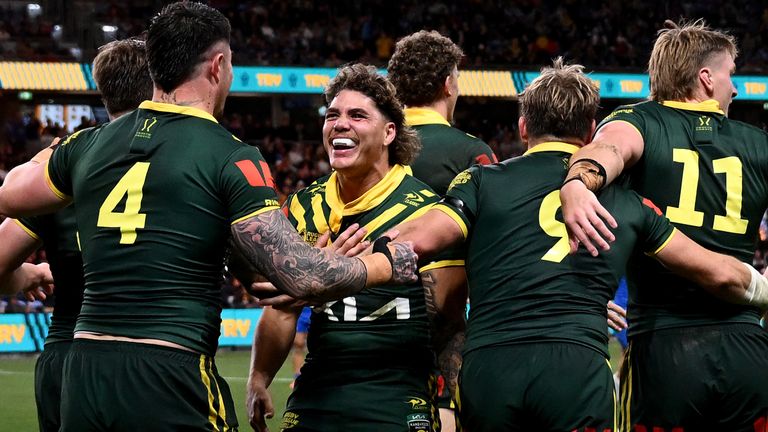
Australia have won the last three world cups
I really cannot split them. I give New Zealand a really good chance but like Australia have done for nearly half a century now, they keep finding ways to win.
When they are down and out, dead and buried, off their game, like they were against Fiji, they find a way to win.
Kalyn Ponga coming back in for New Zealand was a massive boost and he obviously had no problems defensively off the back of his broken arm- he threw himself into tackles and came up with try-savers.
We are in for a sensational final between the two best nations in the world. There are no complaints there.
In the women’s final, I cannot look past the Jillaroos. They are at a level of dominance that I don’t think we have ever seen from the Kangaroos ever.
The scorelines they are posting, their ability to win games at a canter, even sometimes leaving points out there.
It is remarkable. It looks a greater hurdle to catch up with them for the likes of New Zealand and Samoa than the hurdle in the men’s game.
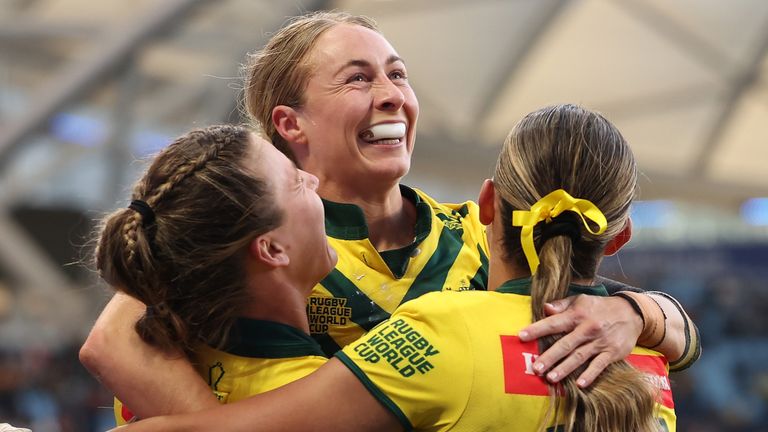
The Jillaroos are in a class of their own in the women’s tournament
Will Tonga rue going all out against Samoa?
I do not think there is a huge amount between Australia, New Zealand, Tonga, and Samoa on any given day. I would not have fallen over in shock if Tonga or Samoa had won either of the semi-finals.
I was probably more surprised that Tonga went full-on against Samoa a week earlier in a game that they did not have to win.
They went all out for that game and it would have taken plenty out of both teams heading into the semi-finals.
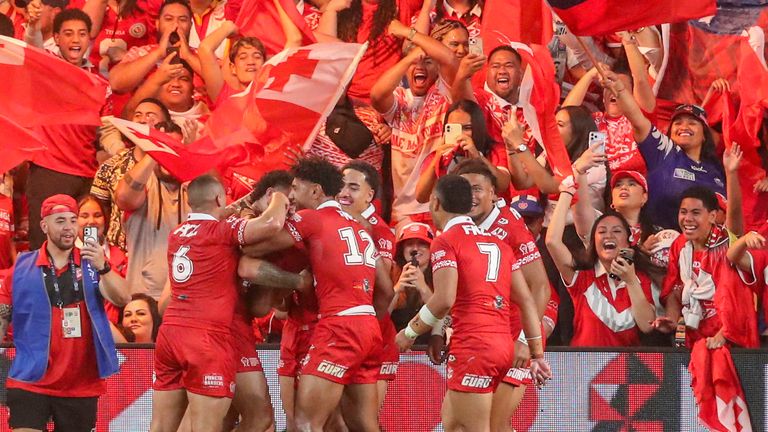
Tonga beat Samoa in their final Pool game but it was a bruising encounter
While I understand and applaud that the emotion of the game and the occasion drove Tonga and Samoa to field strong sides, it didn’t make a whole lot of strategic sense for Tonga in particular. They could have rested players and prepared for their semi-final.
That is not what happened.
I was somewhat surprised at that approach not withstanding the fact the game meant so much passion wise.
The whole purpose was to win the World Cup, not to beat Samoa.
Tonga and Samoa’s Tier 1 status: A warning shot for England?
In terms of Tonga and Samoa now being given Tier 1 status, I would be surprised if that warning shot wasn’t felt all the way back in 2017 when Tonga emerged as a force in international rugby league.
I do not think for a minute that England will have been taken by surprise by the performances of Tonga and Samoa and the subsequent reward which appears to be Tier 1 status.
It is only good for the game and I think people will applaud the efforts that have been made by a variety of people and organisations to get those teams to where they are.
You also have to give a nod to those Tonga players back in 2017. Andrew Fifita, Jason Taumulolo, and Daniel Tupou in particular made the decision to make themselves available to Tonga.
That decision has been the spark that has lit this Pacific rebirth of Tonga and Samoa in international rugby league.
Doing things differently: ‘Magic’ style in 2030
The Rugby League World Cup 2030 is fascinating. We are told it is going to be a Magic Weekend style event where they will descend upon a city for a weekend, play all the games, then decamp to another host city.
That is not a traditional way of doing a World Cup but the mastermind and the brains behind it is Peter V’Landys and the Australian Rugby League Commission.
The ARLC have all the power, all the money, and at the helm they have a man who, in his professional history, has shown a willingness to challenge the establishment and the status quo.
Cast your minds back to 2017 and the Melbourne Cup, one of the most prestigious horse races in the world.
So, if you are the boss of New South Wales horse racing, how do you try and take on the Melbourne Cup? Do you go like-for-like? No.
V’Landys decided to create something different and did the Everest race. The draw would be done differently; the audience and the sponsors they would be targeting would be very different.
It would look and feel very different to the Melbourne Cup and it has been a roaring success by all metrics.
He is not going to take on, for example, the Rugby Union World Cup and try and go blow for blow with them and replicate what rugby union or football does.
‘We are different’ is how he thinks and he will think differently and act differently with this Magic style World Cup.
I am fascinated by it. They have got all the wind behind them at the moment. They have all the money and will to do this.
This is the man who brought games to Las Vegas when people said it could and would not happen and it would not be a success.
While it is not for the traditionalists, V’Landys’ thinking is what is best for rugby league and he might have landed on something there.
That goes hand-in-hand with the extension of the eligibility rules to great-grandparents because he wants Tonga, Samoa, Fiji, Cook Islands, Papua New Guinea. He wants to secure all of Pacifica.
This is another step towards ensuring that these teams have the players available to them to create stories that resonate back in their countries.
We are a nimble sport because we are small, we have got fewer institutional breaks than others which can be good and bad.
It has allowed the ARLC to determine what international rugby league is going to look like.
When you are paying the piper, you call the tune and the ARLC are paying the piper.
Most people in administrative roles spend their lives trying to solve problems. V’Landys seems to make a living discovering that they weren’t problems in the first place.
A necessary domestic limbo?
It is hard to argue that we are not in a case of limbo domestically with so much to be announced and the fact we are in November.
There is a lot going on and if the NRL partnership deal comes to pass, it is a major development in our game and it has taken a long time to get to this point.

If that means a delay on other things, I say so be it. It is not ideal but I won’t lose sleep over it.
It might set back planning but if we get where we need to be at the end of it all, I am sure it will be worth it.
Improvement in the domestic game is vital, not just for international rugby league. We need to continuously improve the domestic game for our audiences, who are our most important people.
They are the lifeblood of the sport.
We have to improve it for those people, you have to keep the product on top for those people.
If the domestic game improves, then you would imagine the international game would improve by extension but your focus first and foremost has to be on the fans and ensuring you are giving them a game they want to watch in increasing numbers and are happy with.
That is the only question you need to answer.