

Ahead of the Grand Slam of Darts 2026, take a look at everything you need to know including the new format, schedule, past winners, and increased prize money up for grabs…
The Grand Slam will see an expanded field of 48 players battle it out for a whopping £1,000,000 in prize money and the Eric Bristow Trophy, all live on Sky Sports.
The competition starts this Saturday November 14 and will run until Sunday November 22. The quarter-finals will take place on November 20 and 21, before the semi-finals on the afternoon of Sunday November 22 ahead of the final in the evening.
What are the groups?

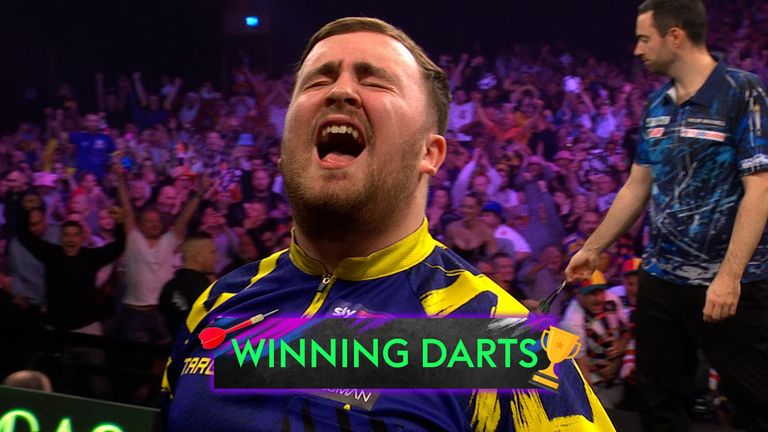
GROUP A
(1) Luke Littler, Niels Zonneveld, Beau Greaves
GROUP B
(16) Jermaine Wattimena, Alan Soutar, Lisa Ashton
GROUP C
(8) Josh Rock, Kevin Doets, Tommy Morris
GROUP D
(9) Stephen Bunting, Cameron Menzies, Raymond Smith
GROUP E
(4) Gerwyn Price, Sebastian Bialecki, Joe Hunt
GROUP F
(13) Ryan Searle, Andrew Gilding, Charlie Manby
GROUP G
(5) Jonny Clayton, Rob Cross, Anton Ostlund
GROUP H
(12) Wessel Nijman, Niko Springer, Adam Sevada
GROUP I
(2) Luke Humphries, Joe Cullen, Paolo Nebrida
GROUP J
(15) Luke Woodhouse, Krzysztof Ratajski, Tom Sykes
GROUP K
(7) James Wade, Ricky Evans, Cam Crabtree
GROUP L
(10) Michael van Gerwen, Jeffrey de Graaf, Henry Coates
GROUP M
(3) Gian van Veen, Bradley Brooks, Carl Sneyd
GROUP N
(14) Chris Dobey, Martin Schindler, Jan Schmidt
GROUP O
(6) Ross Smith, Gabriel Clemens, Rusty-Jake Rodriguez
GROUP P
(11) Nathan Aspinall, Karel Sedlacek, Maik Kuivenhoven
What is the Grand Slam of Darts format?
Instead of eight groups of four, the expanded 48-player field is now split into 16 groups of three.
Rather than the top two in each group progressing like in previous editions, only the top player from each group will progress.
That means each player only has two group stage matches rather than three, so every match will carry A LOT of weight.
Effectively, each group is a round-robin format.
In the group stage, two points will be awarded for a win, and no points are awarded for a defeat.
Should there be a three-way points tie in any group after the round-robin games have been played, these would be split as follows:
Total leg difference
Total legs won
Total legs won against throw
Highest total tournament average (to two decimal places)
Highest winning match average (to two decimal places)
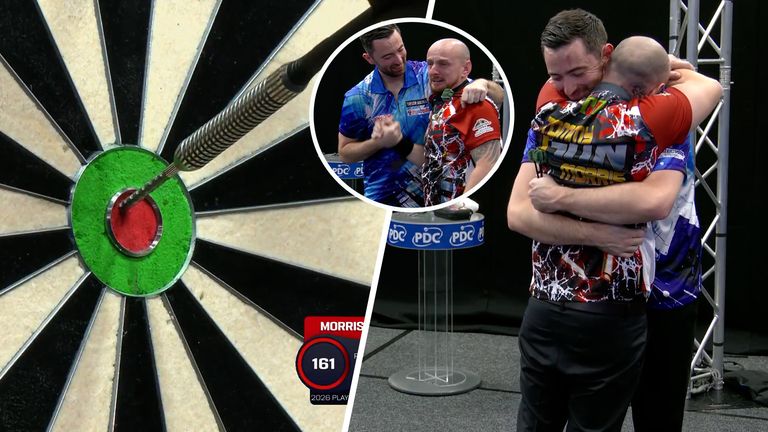
If players cannot be split after the above criteria, a play-off will be organised between the players at the end of the session in which the final group game is played and will be a two or three-way nine-dart shootout in which the player scoring the most points is deemed the winner.
The order of throw would be determined by PDC ranking, with the highest ranked player having the option to throw first, second, or third.
Following the completion of the Group Stage, each group winner will progress to the knockout stage from the last 16 onwards, and the tournament will proceed in bracket order as follows:
- Winner Group A v Winner Group B
- Winner Group C v Winner Group D
- Winner Group E v Winner Group F
- Winner Group G v Winner Group H
- Winner Group I v Winner Group J
- Winner Group K v Winner Group L
- Winner Group M v Winner Group N
- Winner Group O v Winner Group P
When and where is the Grand Slam of Darts?
The event takes place from Saturday November 14 through until Sunday November 22, live on Sky Sports.
The tournament is held at the WV Active Aldersley, Wolverhampton, with bumper crowds expected at every session.
Last year, Luke Littler came through with a 16-11 victory over Luke Humphries to go back-to-back in the major. In 2026, he will be going for his third Grand Slam title in a row.
What is the prize pot?
The money has gone up! The prize pot has increased from £650,000 in 2025 to a whopping £1,000,000 in 2026 thanks to the expanded field.
It means that the winner of the major will now take home £200,000, the runner-up clinching £100,000.
The semi-finalists will secure £60,000 and the quarter-finalists will leave Wolverhampton with £35,000.
If you make it to the last 16, £20,000 is the prize, while finishing second in a group means £12,500.
If you finish bottom in your group, you leave with £5,000.
Who are the previous winners?
Littler is the most recent winner in 2024 and 2025, with Humphries claiming glory before him in 2023.
Michael Smith ended his PDC major jinx in 2022 as he held the Eric Bristow Trophy aloft following his convincing 16-5 win over Nathan Aspinall.
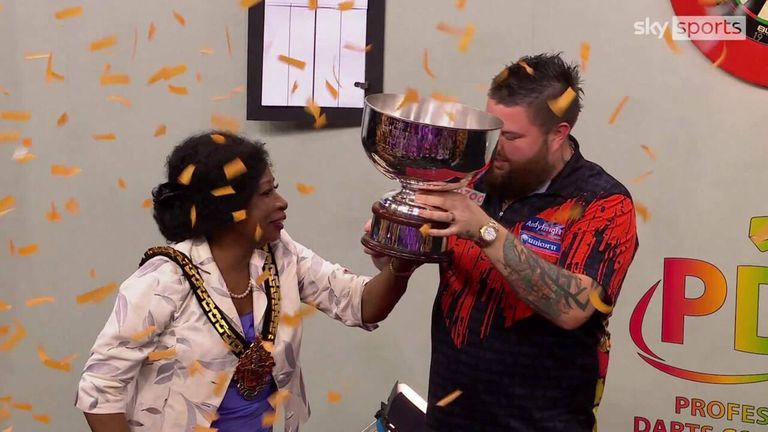
Since 2007, there have been just nine different winners of the Grand Slam of Darts. Phil Taylor is the most successful in the tournament with six victories, Van Gerwen and Gerwyn Price in joint second with three apiece.
Littler could join that list with a third win in three straight years.
Although there have only been eight winners, 19 different players have competed in the final with the likes of James Wade, Peter Wright and Anderson unable to pick up the trophy. Martin Lukeman was the latest to join that list in 2024.
How many nine-darters have been thrown?
Luke Humphries became the seventh player to throw a nine-darter in Grand Slam of Darts history during his victory over Michael Smith in Group A back in 2025.
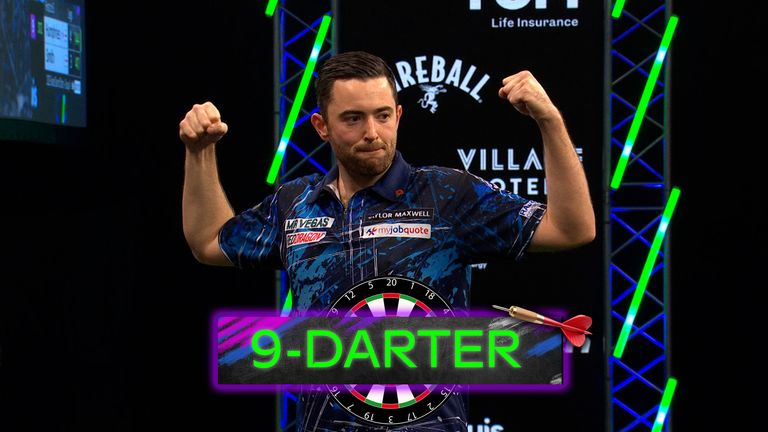
Humphries took out 144 to complete his third nine-darter of 2025 and wrap up a 5-3 victory, his second win of the tournament, with the ‘perfect leg’ the first at the event since Ryan Searle hit a nine-darter to win his Group D match against Nathan Rafferty in 2023.
The first came from Wade back in 2008, with Josh Rock, Dmitri Van den Bergh, Dave Chisnall and Kim Huybrechts the others to do so. No player has previously fired a nine-dart leg at the Grand Slam of Darts and gone on to win the tournament that same year.
Sky Sports remains the home of darts with the Grand Slam of Darts (November 14-22) and World Darts Championship (December 11-January 3) all live. Stream darts and more through NOW with no contract.